Hemp Explained: Understanding the Plant, Its Uses and Its Place in Modern Wellness
Introduction: Why Hemp Has Become a Major Modern Conversation
Hemp is one of those plants that seems to exist in several worlds at once. It can be discussed as an agricultural crop, an industrial material, a botanical ingredient, a source of food and oil, a subject of cannabinoid research, and a growing part of the modern wellness marketplace. For some readers, hemp is immediately associated with CBD. For others, it brings to mind textiles, rope, seeds, farming, or cannabis policy. All of those associations reflect parts of the larger hemp story, but none of them alone completely explains the plant or its importance.
Part of the confusion surrounding hemp comes from the fact that the plant has a long cultural and agricultural history while also being connected to a rapidly changing modern industry. Hemp belongs to the Cannabis sativa species, which means conversations about hemp often overlap with broader discussions about cannabis. Yet the way hemp is cultivated, regulated, processed, marketed, and used can differ significantly from other cannabis varieties. Legal definitions also vary by jurisdiction, usually relying on limits involving certain cannabinoids, particularly THC, rather than creating a completely separate botanical species.
As public interest in CBD and hemp-derived products has expanded, the amount of information surrounding hemp has increased dramatically. Consumers may now encounter hemp in foods, oils, cosmetics, personal care products, botanical formulations, textiles, building materials, and wellness products. At the same time, scientific researchers continue studying cannabinoids and other plant compounds, while agricultural researchers explore hemp cultivation, fiber production, sustainability, and industrial applications.
Hemp Heaven was created to help make these conversations easier to understand. Rather than treating hemp as a miracle crop, a passing trend, or a single-product industry, it is more useful to examine the plant from multiple perspectives. Understanding hemp means looking at its biology, history, uses, terminology, consumer products, research, and place within modern culture.
What Is Hemp?
Hemp generally refers to varieties of the Cannabis sativa plant cultivated for legally recognized agricultural, industrial, nutritional, or cannabinoid-related purposes. Legal definitions can differ depending on location, and many jurisdictions distinguish hemp from other forms of cannabis using limits on the concentration of particular psychoactive cannabinoids. Because laws and regulations continue to evolve, the exact legal meaning of hemp should always be considered within the relevant jurisdiction rather than assumed to be identical everywhere.
Botanically, hemp and other cannabis plants share many characteristics. They belong to the same species and can contain a variety of naturally occurring plant compounds, including cannabinoids, terpenes, flavonoids, fatty acids, and other constituents. What makes a particular crop legally or commercially categorized as hemp is often connected to genetics, cultivation goals, cannabinoid composition, and regulatory definitions rather than a simple visual difference that always separates one plant from another.
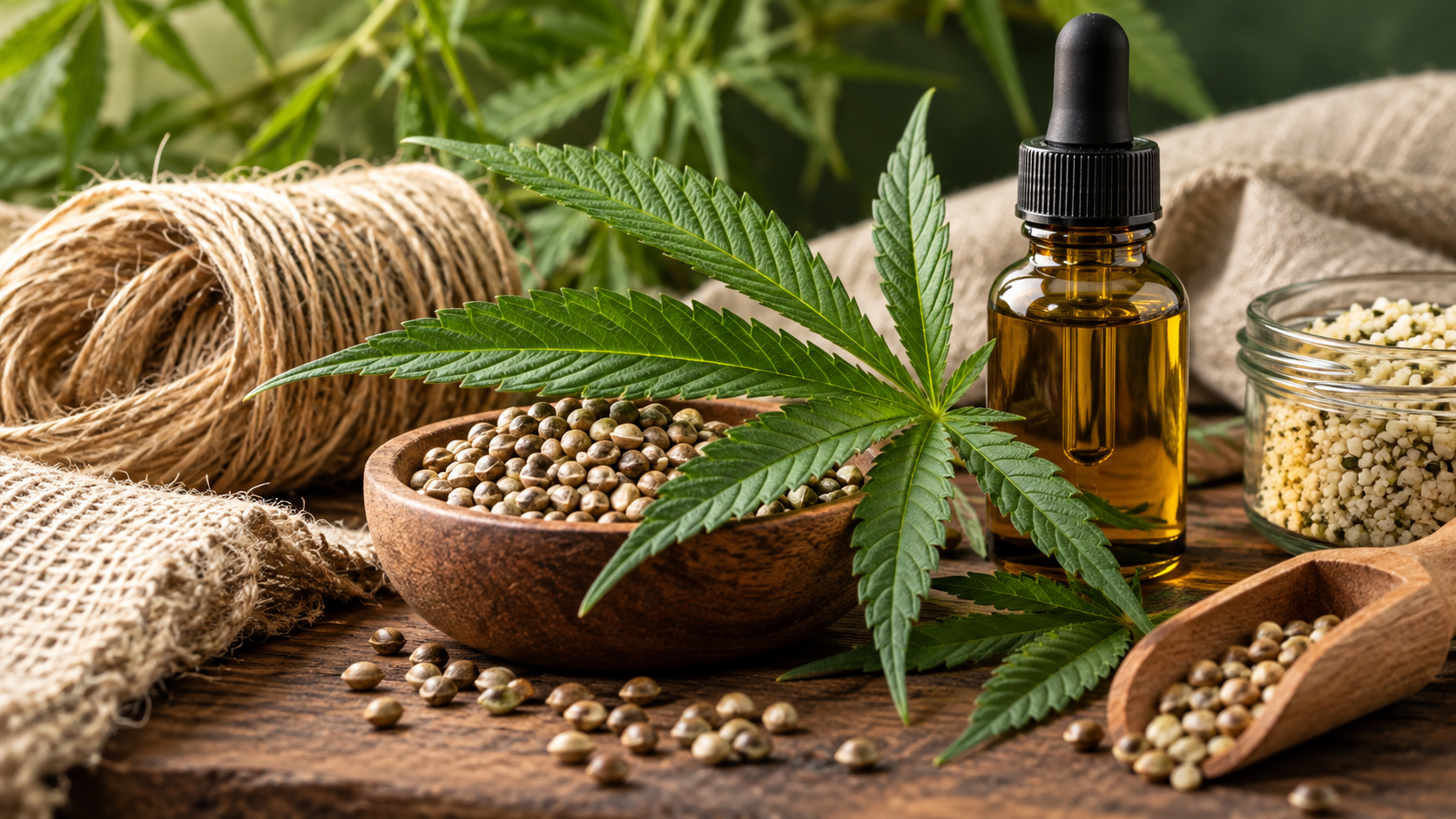
Farmers may cultivate hemp for very different purposes. Some varieties are selected for tall stalks and strong fibers. Others are grown for seeds that can be used in food or pressed for oil. Still others are cultivated for flowers that contain cannabinoids such as cannabidiol, better known as CBD. These different cultivation goals can affect plant structure, harvesting methods, processing, and the types of products eventually produced.
Understanding this diversity is important because the word “hemp” can refer to many different things. Hemp fiber, hemp seed oil, hemp protein, hemp-derived CBD extract, and hemp-based building materials may all originate from the same plant species, yet their composition, purpose, and consumer use can be completely different.
A Long Agricultural History
Hemp is not a newly discovered plant. Human societies have cultivated varieties of Cannabis sativa for thousands of years, particularly for fiber, seed, and practical materials. Historical evidence suggests that hemp and related cannabis varieties were used across different regions of Asia and later spread through trade, agriculture, and migration.
One of hemp’s most important traditional uses was fiber production. The stalk of the plant contains long bast fibers that can be processed into strong material suitable for rope, cordage, textiles, and other practical applications. In societies where natural fibers were essential for transportation, farming, construction, and everyday life, hemp could be a useful agricultural resource.
Hemp seeds also had value as food and as a source of oil. Seeds contain fats, protein, and other nutrients, while pressed hemp seed oil has been used for culinary, industrial, and personal care purposes. Importantly, hemp seed products differ significantly from cannabinoid-rich extracts because cannabinoids are concentrated primarily in other parts of the plant rather than in the interior of the seed itself.
The historical role of hemp changed as industrial production systems, synthetic fibers, agricultural policy, and cannabis regulation evolved. In many places, hemp cultivation declined or became heavily restricted during the twentieth century. More recent legal reforms have helped renew commercial interest in industrial hemp, creating opportunities for modern agriculture, research, and product development.
Hemp Fiber and Industrial Uses
One of the oldest and most distinctive uses of hemp involves fiber.
The stalk of the hemp plant contains different types of fibers and woody material. The outer bast fibers are long and strong, while the inner woody core is often referred to as hurd or shiv. These plant materials can be processed for different industrial purposes.
Hemp fiber has historically been used in products such as:
- Rope
- Textiles
- Canvas
- Cordage
- Paper
Modern industries have also explored hemp in newer applications, including composite materials, insulation, packaging, automotive components, and construction materials.
One example that has received public attention is hemp-based building material made by combining processed hemp hurd with a mineral binder. These materials are sometimes discussed for insulation and sustainable construction applications. However, the environmental performance of any building product depends on many factors, including agricultural methods, processing, transportation, durability, energy use, and the specific construction system involved.
This is an important reminder that hemp’s industrial potential should be evaluated through evidence rather than promotional claims. A plant-based material is not automatically environmentally superior in every situation simply because it comes from a renewable crop.
Hemp Seeds and Food Products
Hemp seeds represent another major area of hemp use.
Shelled hemp seeds are consumed as a food ingredient and are valued for their combination of protein, fats, and other nutrients. They can be added to foods such as oatmeal, salads, smoothies, baked goods, and other recipes.
Hemp seeds may also be processed into:
- Hemp seed oil
- Hemp protein powders
- Hemp flour
- Hemp-based beverages
- Other food ingredients
Hemp seed oil is particularly important to distinguish from CBD oil. Although both products may be associated with the hemp plant, they are not interchangeable.
Hemp seed oil is pressed primarily from seeds and is used as a food or cosmetic ingredient. CBD oils, by contrast, usually involve cannabinoid-containing extracts derived from cannabinoid-rich portions of the plant and combined with a carrier oil.
This distinction matters because consumers may sometimes see the word “hemp” on packaging and assume that all hemp oils contain significant amounts of CBD. Reading ingredient lists and product descriptions carefully is therefore an important part of consumer awareness.
Understanding CBD
CBD, or cannabidiol, is one of the most widely recognized compounds associated with modern hemp products.
It belongs to a group of naturally occurring plant compounds called cannabinoids. Cannabis sativa contains numerous cannabinoids, although the amounts and ratios can vary considerably depending on genetics, cultivation conditions, plant part, harvesting methods, and processing.
CBD differs from THC in important ways, including its psychoactive profile. However, public discussions about CBD can sometimes become overly simplified, especially when marketing language presents the compound as though its effects or uses are completely understood.
Researchers continue studying CBD in a variety of contexts. Some uses of purified cannabinoid medicines have been studied and regulated in specific clinical settings, but that does not mean every over-the-counter hemp or CBD product should be treated as equivalent to an approved medicine or as proven to address a particular health condition.
The difference between scientific research and consumer marketing is extremely important. A study involving a controlled pharmaceutical formulation, specific dose, monitored participants, and defined medical condition cannot automatically be generalized to every commercially available CBD product.
What Are Cannabinoids?
Cannabinoids are naturally occurring chemical compounds found in cannabis plants.
CBD and THC receive the most public attention, but they are not the only cannabinoids researchers have identified. Other cannabinoids are also being studied for their chemical properties and biological interactions.
Plants may contain cannabinoid acids that can change through heat, storage, processing, or other conditions. This chemistry is one reason cannabinoid product labels can include multiple names and abbreviations.
For consumers, it is not necessary to become a professional chemist to understand hemp products. However, knowing that cannabinoid composition can vary helps explain why two products labeled “hemp extract” may not be chemically identical.
Differences can involve:
- Cannabinoid concentration
- Extraction method
- Plant material
- Additional ingredients
- Processing
- Testing
- Product formulation
These differences are part of why product transparency matters.
Hemp-Derived Product Categories
The modern hemp marketplace contains many types of products.
Common categories may include:
- Hemp foods
- Hemp seed oil
- Topical botanical products
- CBD oils
- Capsules
- Personal care products
- Cosmetic products
- Hemp fiber goods
These categories should not be treated as though they all have the same purpose.
A hemp textile and a CBD tincture, for example, are both hemp-related products but belong to completely different industries. One is primarily a material product, while the other involves cannabinoid formulation and consumer wellness considerations.
This broad range of applications demonstrates why hemp is better understood as an agricultural platform than as a single product category.
Product Labels and Consumer Awareness
As hemp products have become more common, label literacy has become increasingly important.
Consumers may encounter terms such as:
- Hemp extract
- Full spectrum
- Broad spectrum
- CBD isolate
- Hemp seed oil
- Cannabinoids
- Terpenes
- Botanical blend
These terms can describe meaningful differences, but they may also be used in marketing contexts that are not always immediately clear to consumers.
A thoughtful consumer approach involves looking beyond the front label and reviewing information such as:
- Ingredient lists
- Manufacturer details
- Testing information
- Cannabinoid content
- Product type
- Serving information
- Warnings
Third-party laboratory testing is frequently discussed in the hemp industry because testing may provide information about cannabinoid concentrations and contaminants, depending on what the laboratory actually tested. However, simply stating that a product is “lab tested” does not explain the quality of the testing, laboratory standards, sample handling, or whether the test results correspond to the product being sold.
Transparency matters because labels are one of the main ways consumers evaluate what they are purchasing.
Hemp and Botanical Wellness
Hemp is frequently positioned within the broader botanical wellness industry.
Botanical wellness refers generally to the use or discussion of plant-derived ingredients within lifestyle, personal care, food, and wellness contexts. This area often combines traditional practices, contemporary formulations, consumer trends, and scientific research.
Hemp fits naturally into this conversation because it is both an agricultural crop and a source of plant compounds that researchers continue to study.
However, responsible botanical education requires separating cultural traditions from established clinical evidence. The fact that a plant has historically been used in a particular way does not automatically prove a modern medical effect. Likewise, laboratory research involving a plant compound does not automatically establish the effectiveness of a commercial consumer product.
Hemp Heaven approaches botanical wellness with an emphasis on understanding rather than exaggerated promises.
Hemp Research and Scientific Interest
Scientific research involving hemp and cannabinoids has expanded significantly.
Researchers may investigate topics such as:
- Plant genetics
- Agricultural performance
- Cannabinoid chemistry
- Extraction methods
- Consumer product quality
- Environmental impacts
- Potential biological effects
The quality and relevance of evidence vary depending on the research question.
A controlled human clinical trial, for example, provides a different type of evidence than a laboratory experiment involving isolated cells. Both may be scientifically valuable, but they answer different questions.
Responsible interpretation means recognizing those differences.
Research can generate interest without producing definitive conclusions, and the existence of a study does not mean every marketing claim associated with that study is justified.
Hemp and Sustainability
Hemp is frequently described as a sustainable crop.
There are reasons researchers and industries are interested in hemp from an environmental perspective. It can produce useful biomass, fiber, seed, and industrial materials within an agricultural system.
However, sustainability is not a single characteristic that can be assigned to a plant without context.
Environmental outcomes may depend on:
- Water use
- Soil conditions
- Fertilizer practices
- Pesticide use
- Processing requirements
- Transportation
- Energy consumption
- Product durability
- Local climate
A hemp product manufactured through an inefficient supply chain may not necessarily have a better environmental profile than an alternative simply because hemp was one of its ingredients.
Therefore, sustainability claims should be evaluated using complete life-cycle information whenever possible.
Hemp and Modern Agriculture
For farmers, hemp represents both opportunity and complexity.
Different hemp markets require different agricultural strategies. Fiber production may favor tall plants grown relatively densely, while cannabinoid-focused cultivation may involve different genetics, spacing, harvesting methods, and quality controls.
Farmers also face challenges related to:
- Seed selection
- Regulation
- Crop testing
- Market demand
- Processing infrastructure
- Weather
- Agricultural risk
A successful hemp industry depends not only on growing the crop but also on reliable markets and processing capacity.
If processing facilities are unavailable, even a high-quality harvest may have limited economic value. This illustrates how agricultural innovation depends on complete supply chains rather than a single crop alone.
Hemp Culture and Public Perception
Hemp’s cultural identity has changed dramatically over time.
At various points, it has been viewed as a traditional fiber crop, a controversial cannabis plant, an agricultural opportunity, a wellness ingredient, and a symbol of sustainability.
These changing perceptions reflect broader cultural attitudes toward cannabis as well as legal and economic developments.
Public understanding can sometimes lag behind regulation and science. Some people may assume that all cannabis plants are identical, while others may incorrectly believe that anything labeled hemp is automatically non-psychoactive, medically beneficial, or environmentally superior.
Education helps reduce these misunderstandings.
Common Misconceptions About Hemp
Hemp and Marijuana Are Completely Different Species
They are commonly discussed as separate categories, but both are generally associated with Cannabis sativa. Legal and commercial distinctions often depend on chemical composition, cultivation, and regulatory definitions rather than separate species.
Hemp Seed Oil and CBD Oil Are the Same
They are not.
Hemp seed oil is primarily pressed from seeds, while CBD products generally involve cannabinoid-containing extracts from other parts of the plant.
Every Hemp Product Contains CBD
It does not.
Hemp textiles, foods, seed oils, and many other hemp products may contain little or no meaningful CBD.
Natural Means Risk-Free
No.
Natural substances can still produce biological effects, interact with other substances, or be inappropriate for certain individuals.
Every CBD Product Is Equivalent
CBD products can differ substantially in formulation, concentration, extraction, additional ingredients, testing, and manufacturing quality.
Regulation and Legal Awareness
Hemp regulation has changed significantly in many jurisdictions, but legal frameworks continue to differ.
Rules may involve:
- Cultivation
- THC limits
- Product manufacturing
- Labeling
- Food use
- Marketing
- Testing
- Retail sales
Because regulations change, consumers and businesses should rely on current official sources for legal guidance rather than assuming that information from another jurisdiction applies locally.
Hemp Heaven may discuss policy or regulatory developments for educational purposes, but such content should not be interpreted as individualized legal advice.
Responsible Consumer Education
Perhaps one of the most important developments in the hemp industry is the growing need for consumer education.
Hemp products can be marketed using scientific terminology that may sound authoritative even when the underlying claim is incomplete. Terms such as “premium,” “natural,” “clinically inspired,” “advanced,” or “full plant” can influence perceptions without necessarily communicating measurable quality.
An informed consumer learns to ask practical questions:
What exactly is the product?
What ingredients does it contain?
Does the label clearly explain the cannabinoid content?
Is testing information available?
Are health claims being made that seem unusually broad or absolute?
Does the company explain how the product is manufactured?
These questions encourage thoughtful evaluation rather than automatic trust in advertising language.
The Future of Hemp
The future of hemp is likely to extend well beyond any single product category.
Agricultural researchers continue investigating crop genetics and farming systems. Engineers and manufacturers continue exploring hemp fiber and composite materials. Food producers continue developing hemp-based ingredients, while cannabinoid researchers study complex questions about cannabis chemistry and human biology.
At the same time, regulators, laboratories, manufacturers, healthcare professionals, and consumers continue debating issues such as product quality, labeling, safety, and appropriate marketing.
The most sustainable future for hemp may depend less on hype and more on credible research, transparent business practices, realistic expectations, and useful applications.
Hemp has already demonstrated remarkable versatility. The next phase of its development will likely depend on how responsibly that versatility is translated into agriculture, products, research, and consumer education.
Why Hemp Education Matters
Hemp education matters because the subject sits at the intersection of science, agriculture, wellness, culture, and commerce.
Without basic knowledge, it is easy for consumers to confuse hemp seed oil with CBD, assume every hemp product has the same composition, or misunderstand how research findings relate to commercial products.
Education does not require readers to support or oppose the hemp industry. Instead, it gives them the information needed to evaluate claims more carefully.
The more clearly people understand terminology, plant biology, product categories, research, and regulation, the less dependent they become on advertising language alone.
That is one of the central goals of Hemp Heaven.
Conclusion: Understanding Hemp Beyond the Trend
Hemp is much more than a wellness trend.
It is an ancient agricultural plant with a long history of practical use, a modern industrial crop with diverse applications, a source of nutritious seeds and useful fibers, and a major subject within the expanding cannabinoid and botanical wellness marketplace.
Its modern story is complicated because it brings together agriculture, science, law, culture, consumer products, and public perception.
Understanding hemp means recognizing those different dimensions rather than reducing the plant to a single narrative.
For readers interested in hemp, CBD, cannabinoids, or botanical wellness, the strongest starting point is education. Learn what the terms mean. Understand how products differ. Consider research in context. Read labels carefully. Be cautious with exaggerated claims.
Hemp Heaven exists to make that process easier.
As science, agriculture, industry, and regulation continue to evolve, we will continue exploring the hemp plant with curiosity, balance, and an emphasis on responsible information.
Educational Disclaimer
This article is provided for general educational and informational purposes only. It is not intended to diagnose, treat, cure, or prevent any medical condition and should not be considered individualized medical or legal advice. Readers with personal health concerns, medication questions, or treatment decisions should consult an appropriately qualified healthcare professional.
About the Author
Avery Foster
Avery Foster writes for Hemp Heaven, exploring hemp education, CBD and cannabinoid awareness, botanical wellness, hemp culture, product transparency, and emerging industry research. Avery’s goal is to make complex hemp topics easier to understand while encouraging responsible, evidence-aware conversations about the evolving hemp landscape.